Photo by J. Lloyd
“At what point do professionals in these settings openly acknowledge to them/ourselves that we are participating in systems that are openly unconstitutional and therefore unlawful according to the standards of much of the Western world? Even beyond American law, consider the case of Shawn Sullivan, who fled the US and was on Interpol’s most-wanted list. One of the UK’s highest courts denied a U.S. extradition request on the basis that Minnesota’s program to commit sex offenders indefinitely to treatment violates European human rights law. Lord Justice Alan Moses said returning Sullivan for trial with the possibility of later being placed in the sex offender system would be a “flagrant denial of his rights” under European law.
“With that in mind, professionals might also want to ask at what point we are violating basic human rights when we render “treatment” that no one can ever complete.
“As a profession, we have the research, the tools, and the templates to provide prompt and adequate treatment and to reduce the harm of sexual abuse, and yet we find ourselves in political climates where we cannot use them. At what point do we as individual professionals, or as professional organizations, take a stand against practices that are clearly not working to anyone’s long-term benefit? One need only look at the recent scandal of the American Psychological Association and its involvement with torture to see how collective inaction can ultimately bring disgrace to a profession.”
Read the full article by David Presoctt in Forensic Psychologist.
 “And then there are the patent absurdities created by such laws—signs that legislators, in search of novel ways to torture so-called sex offenders, have abandoned consideration of efficacy or justice. In the case of underage sexting, for instance, a person is both offender and victim at the same time.”

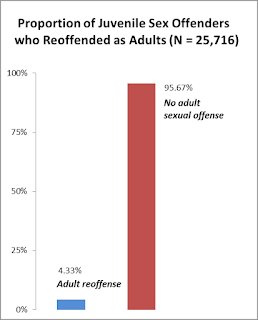 “If you ask John Q. Public about the public safety risk posed by a juvenile who has been arrested for a sex offense, chances are he will estimate too high. The public is woefully uninformed when it comes to risk of sexual reoffense in general, and nowhere is the gap between reality and media-driven anxiety wider than in the case of juvenile sex offenders.”
 “What is sexual victimization? The definitions change with history. It did not occur to me for years that Adam might have assaulted me. Sophie came to that conclusion in a matter of days. What most shaped my perceptions were feminist politics that stress sexual pleasure as much as sexual danger.”
 “Satanism lacks a Jones or Koresh. Satanism has no Jonestown, no Waco, no Kool-Aid, no casual point of reference. This is because Satanic cults, as imagined in popular culture, do not exist. Still, some places across the country—West Memphis, Arkansas; Manhattan Beach, California; Edenton, North Carolina; Austin, Texas—belong to a brotherhood of cities united not by the stunned, silent grief of a tragedy like Waco’s, but by the shame of having left innocent families’ lives in ruin in the fervent pursuit of an imaginary evil.”

